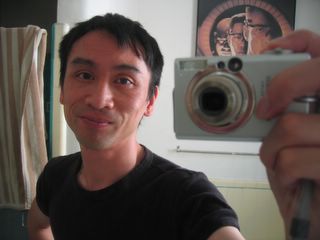
I'm British-born Chinese from Bristol, UK. I’m LA-based. I’m a hip hop aficionado. After 15 years in London I moved to LA to pursue a new career and outlook on life.
Back in the 80s I was a DJ. In the 90s I contributed to the world's first street style exhibition at London's Victoria & Albert Museum. In 2011, I had my first interviews published. Today, I’m keeping busy with music, art, photos and writing.
Sunday, June 15, 2014
El Segundo Museum of Art hosts "Scratch"
El Segundo is where Q-Tip lost his wallet. It's also where the El Segundo Museum of Art (ESMoA) is exhibiting an innovative graffiti art exhibition, in conjunction with the Getty Research Institute.
So, how do some of LA's most recognized graffiti artists get down with ESMoA, the nonprofit, experimental art hub and the Getty? It's not just some hip, flash in the pan. There were two main players: the ideas man, Ed Sweeney, and the institutional supporter, David Branfman.
According to this great article from the Westsider Blog, sometime back in 2011-12 Sweeney, a prolific graffiti art collector, hatched a plan to donate a black book of LA graffiti writers' work to Getty's permanent collection. That resulted Ed and Brandy Sweeney donating the "LA Liber Amicorum" to the Getty Research Institute.
The Latin name means "book of friends" and was inspired by the a rare, 400-year-old manuscript in the Getty Research Institute's collections. The modern day version contains 143 works on paper from more than 150 of Los Angeles's leading graffiti and tattoo artists. (Scroll to the bottom to see a video of the works.)
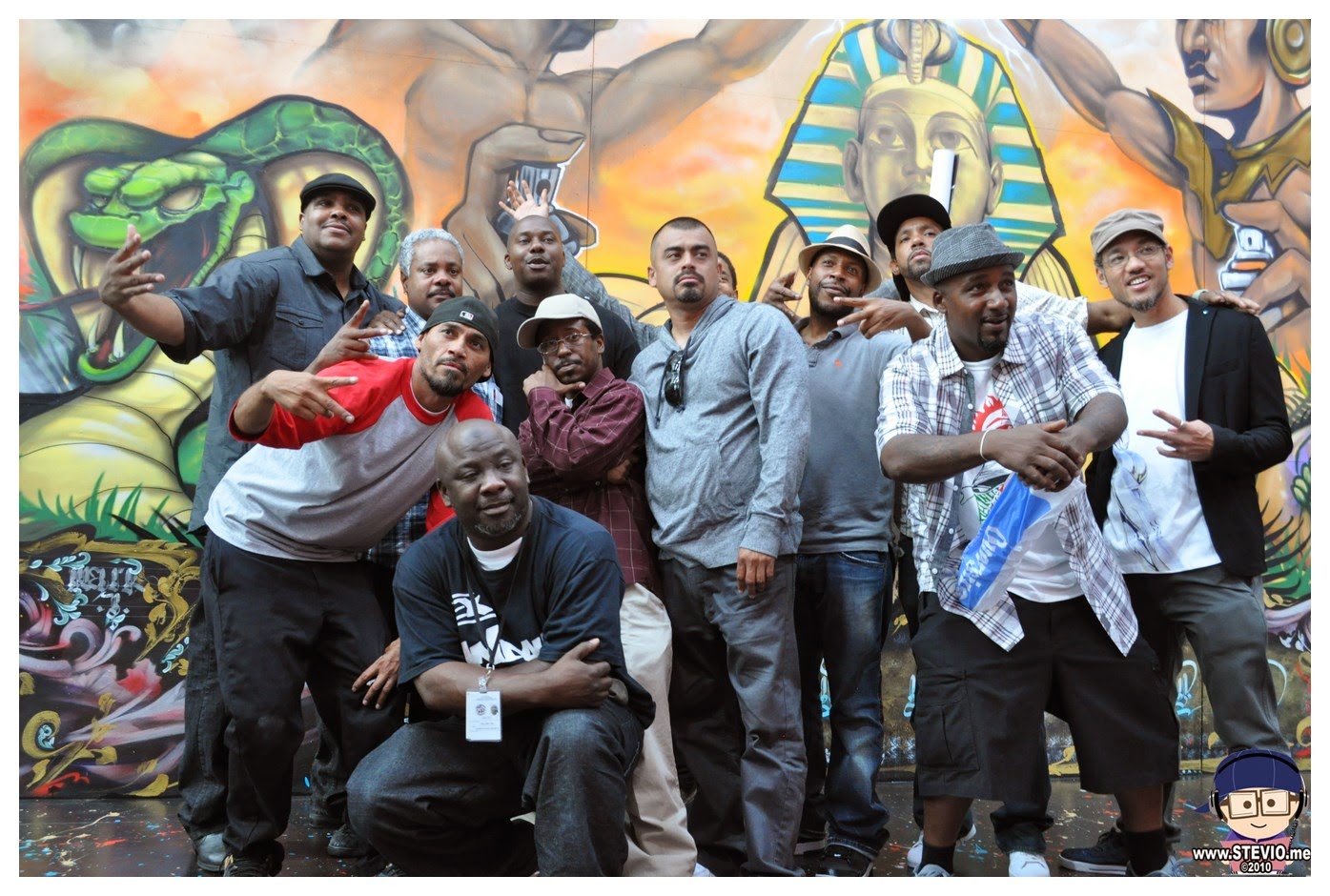
"Sign of the Times" crew led by CRE8 (sixth from left)
Brafman saw a connection between the black books every self-respecting graffiti artist possesses to sketch ideas and get contributions from other artists and the ancient black books. Back in those days the leather-bound book would have been filled with sketches of coats of arms, watercolors, poetry, and calligraphy.
SCRATCH is at ESMoA until Sept. 21, 2014 and features 16th- and 17th-century rare books from the Getty Research Institute's special collections. The gallery is painted top to bottom by the six graffiti crews led by Axis, CRE8, Defer, Eyeone, Fishe and Miner.
Gajin Fujita's work has strong influences from his graffiti past - Olde English lettering, East Los Angeles tags and stencils. He still uses aerosol, but he has gained a higher level of aesthetic by incorporating his Japanese hertitage and artistic traditions, like gold leaf and Ukiyo-e woodblock designs. He has also gained the establishment's respect through these initials, BFA and MFA.
These are not gang affiliations or graffiti crews Fujita is down with. These credentials are his fine arts education gained from Otis and University of Nevada. With these, Gaijin Fujita has gained entry into exhibtions at Los Angeles Contemporary Museum of Art and Kemper Museum of Contemporary Art in Missouri. He is also represented by LA Louver gallery in Venice, California.
"Made in L.A.," Gajin Fujita (2011)
High Voltage II, Gajin Fujita (2011)
Opposites Attract What attracted me Fujita's work was his bold graffiti imagery, his strong connection to Los Angeles and the Asian influences. Samuri warriors, geishas, dragons, gold leaf. The juxtaposition of 17th Century Japanese artcraft with 20th Century "K2S" (Kill to Succeed) graffiti tags and letter styles.
Kill 2 Succeed reference book of styles, Big Sleeps and Defer
Take Two This week, Gajin Fujita was featured in two art shows in Los Angeles. Both shows opened on the same night and I still didn't get to meet the artist. Right place, wrong time?
I got to see his work at the "LA Heat" exhibition, which runs until July 12th at the Chinese American Museum, details below.
LA Heat, Gajin Fujita (2014)
I still need to go see his drawings being exhibited at LA Louver gallery in Venice, CA.
Study for Bewitched, Gajin Fujita
"L.A. Heat" will run through July 12, 2014.
Chinese American Museum, 425 North Los Angeles St., Los Angeles.
www.camla.org.
(Suggested admission is $3 for adults, $2 for seniors 60 and over, and students with ID.)
"Gajin Fujita: Drawings" will run April 26th, 2014
L.A. Louver
45 North Venice Boulevard, Venice, California 90291
Tel: 310.822.4955
www.lalouver.com
#UNleashed Magazine: "The Past According to Futura" #ArtInTheStreets #Futura
This is the last of four articles I wrote for UNLeashed Magazine in 2011 to celebrate the "Art in the Streets" exhibition at LA's Geffen Contemporary at MOCA (Museum of Contemporary Art.) Reviewing my interview with Futura over two years later I am still in awe of insights he shared with me and the context he gave to the fragments of hip hop history I have experienced since I fell in love with the culture in 1982-83.
A 30-year career for a graffiti artist is rare. It takes a special breed of talent and the confidence to take your art beyond the train yard, basketball court and gallery to new platforms and levels of creativity to reach broader audiences. Futura [2000] is one of the few artists who has constantly reinvented himself, always looking forward and rarely looking back. UNleashed Magazine spent an evening talking with Leonard McGurr, aka Futura, at his home in Brooklyn, ahead of his participation in the Art in the Streets show opening at The Geffen Contemporary at MOCA (Museum of Contemporary Art) in Los Angeles.
MOCA exhibition entrance (photo credit: Stevio)
Futura’s graffiti career started in 1970 when McGurr invented his tag (a graffiti writer’s nom de plume), to represent himself in the graffiti underworld and disguise himself from the authorities. “Coming up with the name ‘Futura 2000’ – there were a lot of things that I stole that from…The ‘2000’ was my inspiration and the name became something I live by…and I [have] actually survived 30 years…”
In the 70s, what made Futura 2000 stand out wasn’t his catchy sci-fi tag - after all he was preceded by Paul Renner’s 1920s typeface and Lincoln’s concept car of 1955. He stood out because he painted ‘whole cars’ – trains painted from top to bottom – in what became his signature; abstract and emotional blaze of color. His 1980 painted train raised the bar and created a new aesthetic in graffiti art. Futura lays out the milestones in his long career, “1980 I decide to break with tradition and discover the unknown. The abstract wholecar painted over a three-hour period on a cold night in March would ultimately become iconic. Whoa. who knew?”
Futura 2000 whole car 1980 (photo credit: Henry Chalfont and Martha Cooper)
He made the transition to canvas in the 80s and shared a Lower East Side studio with Fab 5 Freddy. This is the period that will be the essence of Futura’s installation at MOCA. “I have a fantastic painting from 1984, [a] kinda large important painting - seven by nine feet. It was a large painting for its time. This particular painting I gave to my wife when she was pregnant…in the summer of ‘84…that’s 26-27 years ago and it’s a great painting to have as a retrospective [of my work]. And I’m gonna match it with another piece that I haven’t even made yet. I’m gonna make it out there [Los Angeles]. It’s not the ‘yin and the yang,’ but the ‘then and the now’.”
Futura paintings 1984 and 2011, Art in the Streets (photo credit: Stevio)
On the importance of the MOCA show, Futura is very clear. “It is great that Jeffrey [Deitch] has done this, because...people [will] want to talk about the history of the movement…[And] being selected as one of the artists [at MOCA] is awesome…this is probably the first real recognition by an American institution…of the entire movement.[Not just] individuals like Basquiat and Haring who had already been recognized.” As an elder in the graffiti world, Futura is philosophical about what the exhibition will do for the street art genre as well as artists’ careers. “I’m not looking at the show [to say] ‘hey I’m in MOCA!’ It’s one aspect of me as a person. It’s not that important! I’m sure to some of these kids this is it! This is like ‘oh, God dude I’m in! I’m gonna cash in on this,’ or whatever the motivation will be. I’m grateful and I will represent myself very well.”
“I think this show will inflate some peoples’ prices and that should be good for them. I’m grateful for MOCA and I’m excited, but I don’t see it as the defining moment in my career. I think it’s a great moment for the movement…but how many people are in the space, literally inside the show? How many kids who didn’t make it in the show are part of the exterior events? [Ask yourself] not who’s in, [but] who’s out!”
Art in the Streets artist group photo (credit: Stevio)
Futura Past You have to understand Futura’s past to truly understand his point of view. He got recognition during the first gallery love affair with graffiti art in the 80s. He exhibited in the Tony Shafrazi gallery in 1982 alongside Kenny Scharf, then again in 1984 with a solo show. But he was given the cold shoulder after galleries and collectors turned their backs on graffiti art and moved on to more traditional, highbrow art. In response to that boom and bust era, he looked for other avenues to channel his creativity. He reflected, “I didn’t want to be part of the movement 24/7…I diversified my creativity is how I see it. I did a lot of things with my talent and I wasn’t a one-dimensional player. [Now, with MOCA] the art world has come to me. I’ve tried to avoid it…but here it is.”
Earlier this year, fine art auctioneer house, Bonhams, sold one of Futura’s installation pieces painted live in 1983 while he was on tour with the UK punk rock band, The Clash. The four by eight foot painting sold for just under $60,000. “It’s an awesome price and it’s great for the person who profited from that,” said Futura, “I’m not bitter [or asking] ’where’s my percent[age]?’ I don’t worry about those things or play the numbers game.”
credit: Bonhams
“I’m not a collector of my own work, or for that matter of fact, anyone’s work…there’s only one painting in my apartment [and it’s] of my kids. It’s not like I need to be around my work…if there is some potential business [from MOCA I will look at it], but I will [continue to] be as stingy and cheap with my own work as I’ve ever been. Hey, I don’t even have [any of] it! So it’s hard to come by. Just because there’s going to be a rush on it doesn’t mean I’m going to fill it either…I’m never drawn by that [money], that’s not my motivation.”
Outernational As with many things, foreign collectors seem to appreciate the graffiti aesthetic more than at home. Collectors of Futura’s work outside of America have been consistently supportive over the years, so why not move abroad like some of his contemporaries? Futura explained how it was in the early 80s, “People like Jon One, Toxic, Quik, didn’t really expatriate until ‘83/’84…First of all, I’m from New York so I’m not going anywhere, although I have been to 70 countries…and I loved it. All the subsequent exhibitions were based on European interest in our work. [It came from] the people in France who bought; the Dutch who bought a lot, as well as the Germans and the Italians. They all supported our art, whereas no one in New York was supporting it, except for the high-end guys – Basquiat, Haring, Scharf. I sold some paintings; no doubt, I had a moment, but no one was buying graffiti art with any consistency. I was never going to leave [New York]; but people left because that’s where the money was.”
Bonjour hip hop In 1982, Futura visited France for the first time as part of the New York City Rap Tour. This was masterminded by journalist Bernard Zekri who befriended Afrika Bambaataa (founder of Hip Hop’s influential Universal Zulu Nation) and Jean Georgakarako (better known as Jean Karakos) the man behind French new wave record label, Celluloid Records. This period is one of folklore, but it is clear that commercial interests had already infiltrated hip hop. Futura recalls that time, “Prior to the tour, there was a French rush on our movement [hip hop] and it occurred with a few articles that were done with [Fab 5] Freddy, myself and Bambaataa about this new phenomenon…it wasn’t called hip hop yet. The creation of the records [I painted the sleeves] was all part of Jean Karakos’s marketing strategy.”
Talking about his work for Celluloid and the 1982 Celluloid release of his record Escapades of Futura 2000, “I did those covers [for Celluloid] but those records were an exploitation event and I never got a dime, but I know that they cut a deal with The Clash to get their music. That record was meant to happen as a cassette tape and it predates the [New York City] Rap Tour by seven months. So, when I came back to New York I said to Fred [Fab 5 Freddy] ‘Yo, you gotta listen to this little rap record I did…’ It was my homage to graffiti, but I never wanted that to be a fucking record…and Celluloid cut other records (Fab 5 Freddy’s Change the Beat, DST’s Megamix II and Phase II’s The Roxy). All this record shit gets done prior to this tour. Why? Because they have to sell something on the tour. At the time, I was totally manipulated, but I didn’t mind because ‘we were all going to Paris!’”
Fast Forward to the 90s “1985 the Eighties peak; mid decade... those with skills and talent find new opportunities. those without; are trapped in history. Bummer!” Futura moved on to the next phase in his career. By the 90s, the fate that Futura firmly believes in continued to push his brand of art internationally into other avenues. “…I met James Lavelle from Mo’Wax in Berlin. As a result of meeting James, I met Hardy [Blechman of Maharishi for whom Futura designed a range of clothing]. A few years later, I hooked up with the Tokyo ‘Harajuku’, über-cool set. Things were happening without any plan or forecast. The gates opened up in Japan. Japan wound up being this place that supported me…and gave me opportunities that I’d never seen before in America…I love Japan. And James was my key…as he was always in with those guys.”
Cultural Overload By 2005, Futura saw the urban culture swelling in popularity. “2005 the MOVEMENT is not just GLOBAL it’s GARGANTUAN.” When asked to elaborate, he added, ”I don’t just mean the art world. It’s the lifestyle and culture…street art, social networking and blogs, in addition to all the consumer culture like Hypebeast and Freshness. No longer do we live in niches; all the circles cross over each other. There’s the community of artists and designers and the ‘cool boy’ stuff. In ’05 it hit a curve, [and became] another movement that was bound to explode – it was too much – and now we’re in this recovery period. I think the movement glutted on itself, it got too high on itself, fed off of itself and it got sick. I’m weary of all that. I can be in it, but when I’m in it, I am never really believing it.”
In April, Futura travels to Los Angeles in preparation for the Art in the Streets show. “I’m looking forward to going to LA just to check out the work on the street, ‘cause I’m sure there’s a ton. I think I’ve seen all there is to see in New York, which is almost depressing.” As the MOCA show shines the spotlight on him once more, like many forefathers of a movement, he’s protective of what he’s pioneered and outspoken about those who follow in his footsteps. Referring to the new wave of street artists, Futura opines, “I take a lot of photos, so I’m aware of the new kids on the block. I don’t mean the bigtimers like Twist, Swoon, Barry McGee or Shepard Fairey. I’m talking more about the people who haven’t made it yet.”
Futura, Art in the Streets 2011 (photo credit: Stevio)
“It kinda makes me angry that artists who are out there today don’t get the historical perspective; they simply jumped on a bandwagon that had gained momentum…happy to jump aboard and reap the benefits; and they don’t care about, or respect the forefathers or pioneers. I claim some stake in the way it has all panned out 30 years later.”
Talking about street art, Futura says, “I like some of it, but I don’t get anything [emotional from it]. It’s very strange.I get that in galleries also.” He continues, “It’s not just technical ability; it’s energy and emotion which I think certain artists [need to] deliver which is beyond even the work. You [need to] get more of a feel for the person, and that’s hard to translate with a lot of street art. It’s very cold, I don’t get a lot of warmth from it…”
Futura, the artist, is multi-faceted and his work has seeped into every aspect of urban culture, but Futura the man is very much centered around his family whom he considers to be his greatest achievement. “I’m proud of my kids –they’re children of the globe, but Brooklyn is at the heart. My wife laid out the plan...If I need technical advice I call my son, if I need the truth I call my daughter…”
So, what’s next for Futura? “I’d still like to make a movie…I’m still young enough to do a lot more interesting things…that’s why I don’t like to reminisce, although this [MOCA] show makes us look back. It’s not what I do…I’m Futura, I’m the guy who’s looking ahead. It’s no disrespect…I’ve always been that guy.”
A rare treat happens tonight, Richie Mirando, better known as SEEN, will exhibit new works that he painted in Paris at Fabien Castanier Gallery in Los Angeles's Studio City.
The infamous '80s graffiti artist who led United Artists crew in New York has come a long way since this video clip from "Style Wars" produced by Los Angeles's Tom Silver (R.I.P.) and Henry Chalfont.
"...I can't really say that it's art. It just keeps me going...I don't know what I'm going to do after they can't get into the yards any more, after they put up the fences and all..." SEEN, 1983
Here is an interview that Fabien Castanier published last month.
How are you feeling now that you’re back from Paris and living in the U.S?
SEEN: "Honestly, I thought coming back to the US, meaning not coming back to New York but to the West Coast, would be a breath of fresh air and a little more relaxed than it would be for me if I returned to the East Coast. The weather is obviously a bit nicer, but that was the whole idea, to come to the U.S. for the nice weather, get away from the cold, get away from the New York habits that would disrupt my everyday work."
As a native New Yorker, which do you prefer – living in the U.S. or Europe?
SEEN: "I like Europe because it’s old. My whole life I’ve been traveling there. For me, whenever I went on a trip it was about walking down the street, seeing the buildings and the architecture. It always amazed me these buildings – what they looked like, the structure, how they were built – everything. In the U.S., you don't have that. I mean everything is fairly new – it’s only 200 years old! Nothing is really old."
Your super hero body of work is exhibited in galleries around the world and recent auction results have been tremendous. For this upcoming exhibition at Fabien Castanier Gallery, you are exhibiting work that you created while living in Paris. Can you explain how this exhibition is different and what it’s all about?
SEEN: "Honestly, I like to use the word experimenting, but there’s more to it. I’ve always worked in an abstract area my whole life – as early as the 80’s, maybe late 70’s. The graffiti style of work – with the form of the letter – is what took off in the general public’s eye for me. I was painting in other styles at that time too, but I didn’t get a chance to work that deep in those areas. So during the early days, in the 80’s, when I had an opportunity to change my work style and go in a new direction I never showed the works that I was really getting into, which were more abstract. I kept that private, all these years I’ve kept it private. I wasn’t able to fully explore that style up until about 5 years ago. That’s when I got the opportunity to leave the U.S. and made my way to Paris. That was when I had all my energy and all my time. I was able to go back into experimenting in this field."
How did you decide upon living in Paris?
SEEN: "When I got to Paris in 2007, I ended up doing an exhibition there. That’s when I decided to stay. About 10-12 years before that, I was trying to go. At that time, I was trying to get away from the States, to come to Europe to do what I wanted to do, which was to experiment further, but that was never allowed to happen because of family, my lifestyle, my work at the time.
But in 2007, when I landed in Paris, I said “OK, there is nothing to hold me back here at this time. I’m here and I’m gonna stay because if I don’t take this opportunity to stay now, I may never get this chance again.” I only knew a handful of people that I felt I could trust to keep quiet that I was in Paris to do what I wanted to do, to experiment and to help me to do it. So I took 5 years, and I worked 7 days a week. I got to the studio at 9 in the morning and wouldn’t leave until 3 or 4 the next morning. And when I left there, I would go home, sleep a few hours and do the same thing the next day. It was all about going further, where I could take this and it gave me a lot of energy to do it, a lot of time. No distractions. It was a beautiful moment in time."
So do you find it humorous that you painted all these works in Paris and that they’re going to be exhibited in Los Angeles with a French gallery owner?
SEEN: "Yeah, I tell you, it’s strange that it will happen that way because the truth of the matter is, I figured that they would never be exhibited in the U.S. And if they would be exhibited, they would be exhibited in Europe. I find it ironic? It’s crazy (laughs) that it’s happening this way you know. But I do feel very good that it’s being shown through a French person, as I created it in France. So I feel there is a connection still. For me to show it here in the U.S. with anybody who’s from the US? I don’t think it would have a real feeling for me, like it would lose something for me. So I feel there is this connection there and I feel positive about that."
Did you like the French “joie de vivre” when you were in Paris? What did you think about the French people?
SEEN: "Right off the bat, and this is the God honest truth, I had no problem with them. My whole life, I hear, “The French are a little snooty, especially to the Americans...” My experience though, with the French, was… NEVER, never did I have a problem, even when I ventured out on my own. I don't speak the language and I still had good feelings. Wait, I had one problem there. The food! When you go to a restaurant in Paris, the chef is the chief. This is the way the food comes, there is no changing it. You can’t tell the chef how to cook it. You can’t tell him “No, I don’t want mushrooms” or “No, I don’t want sauce” or “ I want extra”. It comes the way it comes. Thats the only thing! Do NOT argue with the chef. That’s what I learned. Cause I’m a very picky eater so it was a little difficult getting certain food because I need to have my food very very well done. Try to tell the chef that and he’ll come out and tell you to get out of the place. (laughs)"
So be honest, would you go back to Paris for 5 more years?
SEEN: "I tell you, I would live there for 5 more years. But during those 5 years, I would explore more. I spent most of my time in the studio. If I did 5 more years, I would go see more galleries, more museums, and I would see more of the streets that I didn't see. But yes, I would."
Did you find inspiration in Paris?
SEEN: "I found time in Paris (laughs). I found time. And I’m gonna be honest with you, time is what I needed. Inspiration? I guess I found that while I was there because I had that time to experiment, to find it. Any other way, I might not have found it."
Of this series that you created – all this experimentation you were doing – how does this fit into and how is it significant to your larger body of work?
SEEN: "I feel it fits in because an artist needs to grow and to experiment. And if they don’t do that, then they’re not growing as an artist should grow – to see where you can take something, and to me, it’s all part of the process.
"The shame is that it took a long time to get to this point, to produce a large body of work like this. When I was doing works in a similar manner years ago – experimenting – I wasn’t able to bring it all into one huge body like this. When people look at this work, at first they might think it’s overwhelming because it’s 5 years worth of work, “Okay, where did this come from?” Some might not see it fit in. But if you step back and look at the big picture, the form of the letter in graffiti is color blending and design work. The only problem is, the graffiti where I grew up – it was locked into a box, into a frame with an outline. I took the letter, an abstract piece basically, and I was confining it by putting an outline around it . Now, it’s totally released. The only thing that stops it at this point is the end of the canvas. And the truth of the matter is, you don’t even need the canvas, you just go beyond that. The letter just keeps growing."
These paintings that you created in Paris over the 5 years, they are exclusively painted with spray cans. Can you explain this process?
SEEN: "The spray can is a tool that I find to be most comfortable with. I’ve used a paintbrush, an airbrush, I use other mediums and it all works for me but the spray can is the most comfortable. I figured out how to use the spray cans in an unconventional way with different works, with different abstract styles I would do. There is one way where I would take the spray can and take the cap and I would squirt the paint into the cap of the spray can. I let it go into the cap and turn into a liquid form now instead of an aerosol spray, so I just turned it into a different form. Now, I’m using it to drip on the canvases over and over to build up my textures and my colors and my designs. Sometimes, I’ll just lay a canvas flat on a table and I’ll take maybe 10 cans of spray paint and just squirt all 10 cans on the canvas. Then maybe I’ll take a trowel and move it around in a freestyle movement. There are so many ways to use a spray can. It does not have to be just pressing a button down and the spray comes out."
Do you consider these paintings a new direction for you? Will you continue in this direction, and still experiment or was this just a phase in Paris?
SEEN: "Like I said, through the earlier days of my work, I worked in this area. Those 5 years allowed me to explode with it, do many pieces. I feel that I would like to continue with it. The truth is, I did so much with the structure of the letter that I feel – not a block – but I feel that there’s no further that I can go with it because I am happy with where I got with it. I’m happy with the lettering form, it’s my style and that’s what I do within that area. There’s only so many designs I can put in there, so many color variations I can do. So for me, that’s complete."
So in a way, these paintings are a way for you to break from the graffiti style and from what you normally show, for what you are known?
SEEN: "Yes, yes. And it would be great if I break through and if it’s accepted. If it’s not, it’s still ok because I will still explore and experiment with it. It was just so important for me to take that time in my life. I needed to find it and I needed to find that time. And I was lucky to get it because for me, it makes me feel better for what I’ve been doing all these years because you get.... tiresome. You have to figure out what you're looking for and where you’re gonna be happy in life, you know what I’m saying?
People like Keith Haring, for instance, everyone knows his work. Ok, he passed away early. Would he want to paint that same imagery today? And would he have stood the test of time if he still did it today? So these are a lot of questions, a lot of mind games that the artist starts getting in his head, like “Where am I going with this? What am I doing?” But you know what I figured out in the end? No matter what, I’m going to do what I want to do. Maybe one day when I kick the bucket, someone’s gonna open up the door and see all these different works and say, “Hmm, who’s this guy? and who’s that guy and who’s this guy?” and then realize it was just one guy and say, “You know what? See that guy? That guy was an eccentric. He was a fucking genius.” (laughs)"
By many, you are considered a legend in the graffiti and street art world. What do you think about the great excitement surrounding this movement today that you began in the 1970’s? Do You have any insight about this movement today?
SEEN: "In the 70’s, I was a kid. I didn’t think much more of it. You started off writing at school on your desk, then on your books at school. Then before you know it, you’re leaving the school and you’re writing on the school doors. Then on your way home from school, you put these little tags on the mailbox, and so on and so on. As a kid growing up it was cool, but I never would have in my wildest dreams thought that it would start a world movement.
I started to see that happening in the late 70’s, early 80’s, when I started to travel overseas. I was one of a handful of artists that was brought to Europe to start showing work on canvas. And from there, going from the trains to the canvas into a gallery, I was watching myself and others paint the streets of Europe. The Europeans were seeing what we did and then I saw them writing in the streets. I’m watching this thing start to explode. We went from country to country, showing our work and the explosion just got bigger and bigger. And then it got to computers which brought it to the world even faster, it just started to multiply. It’s so crazy what it turned into, not just on the street but it started to change how the public sees art. It trickled into the galleries, into the museums. And then you ask, “Well maybe it’s not gonna last?” Well, we’re talking over 50 plus years now that it’s been happening."
What is your next project or future plans?
SEEN: "My next project? I’m going to build my coffin (laughs). No, ha! My next project is moving again. We’re in LA – this was a quick drop off point for me. I was originally supposed to go into Nevada first. I have a few projects going on there. So my idea was to be closer to my projects and also to be able to have a studio there. So we’re moving into a new space, it’s opening in the next few months. This will be my new project, getting that off the ground. And once I’m off the ground, I can start producing my work again."
What would you say to the people who will be visiting the [UN]SEEN show in February, about this exhibition and about this new series?
SEEN: "The truth of the matter is, those who are not familiar with my work will not be surprised. But those who are familiar with my work will be surprised. All I can tell you is, if you like it I’m happy and if you don’t like it, I’m still happy because I’m happy doing what I’m doing for myself in life at this time.
These graffiti guys who deal strictly with lettering, they’ll label me right away. They’ll come to the show, some of these guys, and they’ll be like, “What is this?!” But hopefully one day, their minds will open up and expand and they’ll see that you need to grow and to move on and to see where it leads you, see where life or your mind expands to lead you."
(UN)SEEN runs from February 23th - March 24th, 2013. Opening night is February 23rd, 2013 7-10pm FABIEN CASTANIER GALLERY
12196 Ventura Blvd
Studio City CA, 91604
Giftin' #5: Legit Los Angeles graffiti billboards #publicworks
Still looking for a unique present for your b-boy or b-girlfriend? This series of mini graffiti billboards produced by LALA Arts could be the answer! Hip hop giftin' idea #5!
How & Nosm, NYC
Risk, L.A., CA
Sket One, CT.
Driving across Los Angeles you will see how much billboards rule Los Angeles. They have even been replaced by L.E.D. megascreens which continue to pollute our environment and clear-headedness even more. So, it's refreshing, albeit illegal, when graffiti artists takeover a strategically placed billboard with an artistic message.
LALA Arts celebrates this act of counter-commercialism by collaborating with some leading lights of the graffiti scene in what is labeled "Public Works." Read more about this initiative below. Surprisingly, the Public Works art series has the support of the out-of-home media agency, MacDonald Media. Could this partnership be a way to control illegal defacing of commercial billboards? Who knows...?
LALA Arts has recreated some of these Public Works on miniature scale which will sit nicely on your bookshelf! Choose from Now & Nosm (NYC,) Risk (L.A.,) or Sket One (CT.) $100 each.
"LALA Arts and MacDonald Media are excited to announce the launch of the second part of the groundbreaking Public Works project, which is currently on display on billboards and outdoor media throughout the greater Los Angeles area. The show premiered at LALA Gallery in downtown Los Angeles in August, where guests were invited to see the works up-close and personal.
The exhibit includes both hand-painted and printed murals which will be displayed throughout Los Angeles on a rotating basis through the end of the year. Contributors include world-renowned artists Ron English and Shepard Fairey, as well as How & Nosm, Insa, Push, Revok, Risk, Seen, Trustocorp, WCA Crew, Uglar and Zes. Participating L.A. billboard companies include Clear Channel, Regency, Mahlmann, Lamar, Empire, and CBS." LALA Arts
This is #2 of my Christmas gift list. It's the best of old skool hip hop stuff...
Some of these Dizzizit! gems are easy to cop, the others may be out-of-stock. All are sweet garms for your closet!
What would make Daryll McDaniels, better known as rapper DMC, come to the West coast? A clothing collaboration with Slick's Dizzizit! clothing label. Taking the recognizable red stripes and block lettering of RUN DMC's logo, Dizizit created a remix: DZT DMC. But not just a t-shirt, but a vest, baseball cap, a couple of hoodies and the freshest letterman jacket.
This Dizzizit! x DMC music video was a promo for the Bombs Drop mixtape drop from Phoreyz. Check the stream below.
Thursday night was b-boy night on L.A.'s Fox 11 News.
Apart from the cliched Venice graffiti walls backdrop this was a great community news piece by Heidi Cuda that gave respect to the b-boy culture and the message of the Universal Zulu Nation: "Peace, Love and Having Fun!"
"The thing about b-boying and b-girling is the cultural part of hip hop. The culture of respect...diversity...knowledge of yourself and people." Asia One, B-Boy Summit co-founder
The Berlin Wall fell in November 9th, 1989. Twenty years later, on November 8th, 2009 a section was permanently resurrected on Wilshire Blvd. in Los Angeles by Los Angeles' Wende Museum. Watch the documentary below to hear from Germans what happened in their country.
Fast forward to to 2012 Driving along Wilshire near LACMA and it's easy to forget that the Wall installation is the largest piece of the Berlin Wall outside of Germany. These 10 sections of the Wall are nearly 40-foot long, but are easily blocked by food trucks lined up opposite the LACMA.
During a visit to the LACMA "Through the Mic series," I had a chance to walk around the Wall. On the street side, you see sections of wall painted by different artists. None of them instantly recognizable to me.
On the opposite side, the Wall reveals three other artists. All of whom are world-renowned street artists: Herakut(Germany), Retna (Los Angeles) and DFace(London.) And overshadowing the Wall is a glass-fronted building with a new installation from Retna. To see it at night, glowing from the lights, is memerizing.
Wall Project and Retna building, 5900 Wilshire Blvd., Los Angeles
The Wende Museum
Open to the public Monday - Thursday by appointment only from 10 A.M. to 5 P.M. (except on holidays). To schedule an appointment, call 310-216-1600 x305 or e-mail ccuevaswolf@wendemuseum.org.
The Museum is open without appointment on Fridays from 10 A.M. to 5 P.M. and a tour of the Museum’s vault is offered every Friday at 3 P.M. Admission is free.
Group Visits
For visits by groups of ten or larger please call to arrange an appointment: 310-216-1600 x305
5741 Buckingham Parkway, Suite E
Culver City, CA. 90230
Last Wednesday, Mary Anne Hobbs, ex-BBC Radio 1 DJ and Ted speaker, came to Los Angeles as a guest DJ. She was on the billing at Low End Theory, the bass-driven, dub-step loving, low-tempo club that has sparked a worldwide revival in head-nodding!
Residents of Low End Theory read like a who's who of the scene: Daddy Kev, The Gaslamp Killer, Nobody, D-Styles and MC Nocando. Read more about the club (affectionately named after the seminal Tribe Called Quest album of the same name) at the LA Times.
Roadblock and U-turn Little did I know that arriving 45 mins after the doors opened was a sure way to wait in line behind 100 clubgoers! And the club doesn't look that big! Should I have known? Well, school is out, Mary Anne Hobbs is a fave of this scene and may be EPROM, the other headliner, is big too. What I do know is that I didn't wait in line. Instead I returned home and downloaded the podcasts to enjoy in the comfort of my "yard."
Moral of the story You can't sleep when you're trying to outpace 100 tweeting youngsters. Get connected! ;) And check out those podcasts...there are 20+ of them, including Mary Anne Hobbs.
Resources
Low End Theory radio: Check out thisLast FM radiochannel dedicated to the resident DJs and various artists who have featured at Low End Theory over the years.
Low End Theory podcasts: download thepodcasts (I recommend iTunes)
BritWeek: Eine and Inkie fly the Union Jack in LA (May 2012)
It took place last month, but it's still worth sharing these images of the painting action between LA and UK graffiti artists.
Mear One painting (credit: WeAreLovelyCreative)
The "paint off" in downtown LA's at the Continental Gallery was part of the on-going British culture push to raise awareness of the Olympic Games this summer in London (and the recent HRH The Queen's Diamond Jubilee.) But what was special was this was PR event were the artists taking part: in the red corner was LA's Mear One and Man One (of Crewest Gallery) were painting live; and in the blue corner were UK's Eine (the man with the store shutter lettering and "Art in the Streets" credit) and man about town, Inkie, flexing their skills.
Inkie (UK) tags a fan's shirt
Eine (UK) paints a version of his "Worth More Than a Scion"
Mear One, Man One, Eine and Inkie painted on Jaguar carhoods (one of the sponsors) and recycled furniture pieces designed by Christopher Guy. I didn't stay for the judges winning votes, but the live painting experience from Mear One would've had my unanimous vote. Sorry UK! :)
In Los Angeles, you could find FAFI, the acclaimed French artist, at spots like Nucleus Gallery, Sixspace and La Brea art wall (remember her Tinkerbell piece?)
Next Wednesday May 23rd, FAFI returns to the US, but this time to New York City's "The Hole" on Bowery for her "Carmine Vaults" book signing. She will be joined by apparel collaborators, Married To The Mob.
See below for a video discovered on Arrested Motion of FAFI ( I presume) narrating her book! Kinda saucy!
"Until now, Fafi (www.fafi.net) has been famous for her sexy, colorful, female characters : the Fafinettes. For her very first comic, she has developed a story based on another of her key characters : Birtak.
One day, Birtak decides to become a ballerina dancer after a trip to Earth.This new extravaganza is not to please his fellow companions more used to hustle everyday in the Carmine Vault. This graphic novel tells how Birtak is going to attempt to live his dream and how dangerous it can be to become yourself. The hero takes you by the hand deep inside into the Fafinettes world -not so cute actually-You’ll meet such mean gals and no-limit behaviors, a hostile and gorgeous wilderness you’ll never want to go there." The Hole
Fafi: The Carmine Vault Book Signing & Reception
May 23, 2012 7-9pm
Cocktails courtesy of Belvedere Vodka
Contact rsvp@newyorkartdepartment.org
21 and over please
I'm British-born Chinese from Bristol, UK. I’m LA-based. I’m a hip hop aficionado. After 15 years in London I moved to LA to pursue a new career and outlook on life.
Back in the 80s I was a DJ. In the 90s I contributed to the world's first street style exhibition at London's Victoria & Albert Museum. In 2011, I had my first interviews published. Today, I’m keeping busy with music, art, photos and writing.
"I love it when she calls my phone
She even got her very own ringtone
If that ain't love then I don't know what love is"
"Cupid's Chokehold," Gym Class Heroes
"...We give a f*&@ about status, who you are tomorrow, whether you beg or borrow or if you hit the Super Lotto, whether your girl looks like a minger or a Supermodel..."
"Wonderful Night," Fatboy Slim
"I wish I was little bit taller,
I wish I was a baller,
I wish I had a girl who looked good I would call her,
I wish I had a rabbit in a hat with a bat and a '64 Impala"
.jpg)
.JPG)
.jpg)
.jpg)
.jpg)
.jpg)


.JPG)


.jpg)


.JPG)


.JPG)


.JPG)
.JPG)
.JPG)